

Latest Scientific Developments in Robotic Surgery (2026)
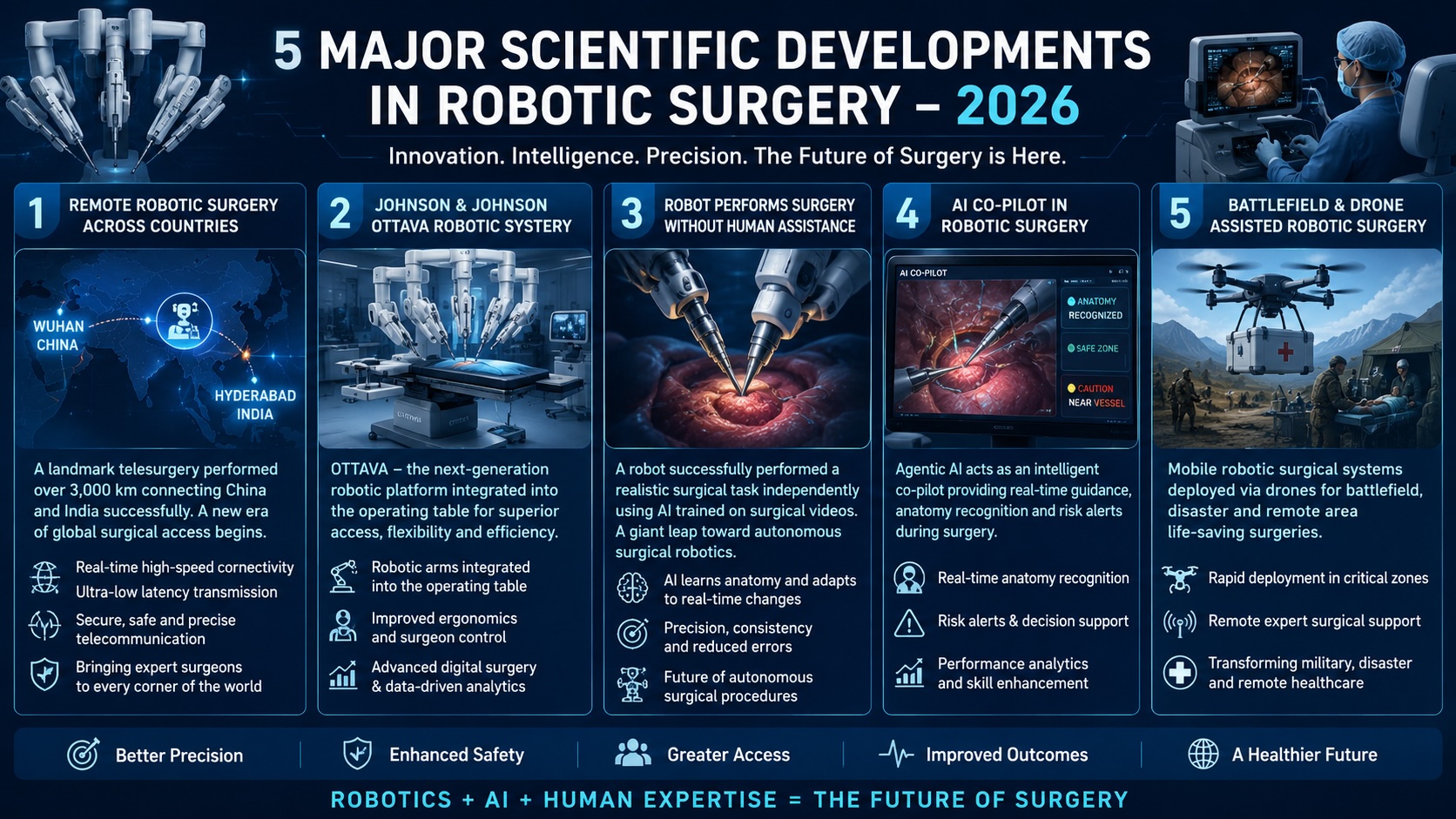
Robotic surgery has entered a transformative era in 2026, integrating artificial intelligence, telesurgery, autonomous robotics, battlefield applications, and next-generation minimally invasive platforms. The field is rapidly evolving from simple robotic assistance toward intelligent surgical ecosystems capable of improving precision, reducing complications, and expanding surgical access globally. Below are five of the most significant recent scientific and technological developments in robotic surgery.
1. Remote Robotic Surgery Performed Across International Borders
One of the most remarkable milestones in robotic surgery this year was the successful completion of a long-distance telesurgery procedure between China and India. An Indian-origin urologist based in Wuhan, China, remotely performed robotic surgery on a patient located in Hyderabad, India, from more than 3,000 kilometers away.
This achievement demonstrated the growing maturity of telecommunication infrastructure, robotic responsiveness, and latency compensation technology. The surgery was performed using advanced robotic instruments connected through ultra-fast communication networks capable of transmitting motion in real time with negligible delay.
The significance of this development is enormous for global healthcare. Telesurgery has the potential to revolutionize surgical access in remote and underserved areas where experienced surgeons are unavailable. Patients in rural regions may soon receive world-class surgical care without traveling internationally.
In disaster zones, military operations, offshore installations, and isolated environments such as islands or polar stations, robotic telesurgery may become life-saving technology. This advancement also opens the possibility for international surgical mentoring, where expert surgeons can guide or directly assist procedures remotely.
From a scientific standpoint, overcoming latency, ensuring secure data transmission, and maintaining precise haptic control were major technological barriers. The successful demonstration confirms that robotic surgical platforms are now capable of stable long-distance operation under real-world clinical conditions.
This breakthrough is also likely to influence regulatory frameworks and medico-legal discussions surrounding cross-border surgery, licensure, cybersecurity, and patient consent in remote robotic operations.
Link:
https://timesofindia.indiatimes.com/etimes/trending/indian-origin-urologist-performs-remote-robotic-surgery-on-hyderabad-patient-in-90-minutes-from-3000-km-away-in-china/articleshow/131291028.cms
2. Johnson & Johnson OTTAVA Robotic Surgical System
Johnson & Johnson announced important clinical study progress for its next-generation OTTAVA robotic surgery platform, marking a major development in competition within the robotic surgery industry.
Unlike traditional robotic systems where robotic arms occupy substantial operating room space, the OTTAVA platform integrates robotic arms directly into the operating table. This design dramatically improves ergonomics, workflow efficiency, and surgeon access to the patient.
The OTTAVA system was specifically designed to address limitations observed in earlier robotic systems, including docking complexity, instrument collisions, and operating room congestion. By embedding the robotic arms within the table architecture, the system allows smoother positioning and greater flexibility during multi-quadrant surgeries.
Another key scientific advancement is the system’s integration with digital surgery technologies and data-driven operative analytics. The platform aims to combine robotics, imaging, machine learning, and real-time surgical feedback into a unified ecosystem.
This reflects a larger trend in robotic surgery where systems are evolving from mechanical tools into intelligent digital surgical platforms. Future robotic systems may automatically recognize anatomy, suggest operative planes, warn against dangerous dissections, and optimize instrument movement.
OTTAVA’s development also signals intensified innovation in the robotic surgery market, historically dominated by a small number of platforms. Increased competition is expected to lower costs, improve accessibility, and accelerate technological advancements.
If widely adopted, systems like OTTAVA may expand robotic surgery into more specialties including colorectal surgery, gynecology, thoracic surgery, bariatrics, and hepatobiliary procedures.
Link:
https://www.jnj.com/media-center/press-releases/johnson-johnson-announces-pivotal-clinical-study-results-for-a-new-soft-tissue-surgical-robotic-system
3. Autonomous Robot Performs Surgical Procedure Without Human Assistance
Researchers at Johns Hopkins University achieved one of the most scientifically groundbreaking milestones in modern surgery by demonstrating a robot capable of independently performing a realistic surgical task with minimal human intervention.
The robot successfully carried out a phase of gallbladder surgery after being trained using surgical videos and machine-learning algorithms. Unlike previous robotic systems that relied completely on surgeon control, this system analyzed anatomy, adapted to tissue variability, and executed surgical maneuvers autonomously.
This development represents a major shift toward autonomous surgical robotics powered by artificial intelligence. The robot was capable of understanding the surgical environment dynamically rather than merely repeating pre-programmed motions.
Machine learning allowed the system to recognize tissue planes, respond to movement, and modify its actions during the procedure. This is especially important because human anatomy is highly variable and surgery often requires intraoperative adaptation.
Although full autonomous surgery in humans remains a future goal, the implications are enormous. Autonomous robotic systems could eventually assist with repetitive, technically demanding, or precision-based components of surgery such as suturing, vessel sealing, dissection, and anastomosis.
Potential advantages include:
- Reduction in surgeon fatigue
- Greater consistency
- Improved precision
- Reduced error rates
- Enhanced surgical training
- Standardization of procedures
This technology may also become critical in situations where expert surgeons are unavailable, such as battlefield medicine, remote environments, or emergency mass casualty scenarios.
However, ethical and regulatory questions remain significant. Issues surrounding accountability, patient safety, informed consent, and machine decision-making will require extensive international discussion before widespread implementation.
Nevertheless, this advancement represents one of the most important scientific developments in surgical robotics in recent years.
Link:
https://hub.jhu.edu/2025/07/09/robot-performs-first-realistic-surgery-without-human-help/
4. Artificial Intelligence as a Surgical Co-Pilot
The integration of “Agentic AI” into robotic surgery platforms has emerged as one of the most important technological trends in 2026. Rather than replacing surgeons, these systems function as intelligent co-pilots capable of assisting decision-making during surgery.
Modern AI-assisted robotic systems can analyze surgical video feeds in real time, identify anatomy, monitor operative progress, and provide context-aware guidance to surgeons. Some platforms are being developed to warn surgeons about dangerous dissection planes, nearby critical structures, or potential bleeding risks.
This technology relies heavily on computer vision, deep learning, and massive surgical data sets obtained from recorded robotic operations. By studying thousands of procedures, AI systems can recognize patterns associated with safe surgical technique and improved outcomes.
Future applications may include:
- Real-time anatomy recognition
- Automatic surgical phase detection
- Instrument tracking
- Performance analytics
- Operative skill assessment
- Personalized intraoperative guidance
- Surgical workflow optimization
AI-assisted robotic surgery may also transform surgical education. Trainees could receive objective feedback regarding economy of movement, tissue handling, efficiency, and procedural accuracy.
Another major scientific advantage is predictive analytics. AI systems may eventually predict complications before they occur by analyzing subtle intraoperative patterns invisible to human observers.
Importantly, AI in robotic surgery is not intended to eliminate the role of surgeons. Instead, it aims to augment human capability, improve safety, and reduce variability in outcomes.
As robotic surgery increasingly becomes data-driven, the future operating room may resemble an integrated digital cockpit where AI continuously assists the surgeon throughout the procedure.
Link:
https://www.emjreviews.com/urology/congress-review/the-future-of-robotic-surgery-j18126/
5. Battlefield and Drone-Assisted Robotic Surgery
Another fascinating development is the emergence of battlefield robotic surgery platforms designed for military and emergency medicine applications. SS Innovations introduced “Project Operion/Vimana,” a system intended to enable robotic surgery support in combat and disaster environments.
The project combines robotic surgical systems with drone-based deployment technologies. The concept involves transporting portable robotic surgery capability rapidly to inaccessible or dangerous areas where conventional surgical infrastructure is unavailable.
This development reflects growing interest in mobile robotic surgical ecosystems capable of functioning in austere environments. In military settings, rapid surgical intervention is often critical for survival. Robotic systems may allow experienced surgeons to remotely assist or directly perform procedures on injured soldiers far from tertiary medical centers.
Potential future applications include:
- Military trauma surgery
- Disaster response
- Earthquake zones
- Remote rural medicine
- Offshore platforms
- Space missions
- Humanitarian crisis regions
Portable robotic systems are becoming smaller, faster, and more adaptable. Advances in imaging, communication networks, battery systems, and compact robotics are making mobile surgical units increasingly realistic.
From a scientific perspective, this development combines robotics, aerospace logistics, telecommunications, telemedicine, and trauma surgery into a unified platform.
The long-term implications are profound. Future emergency response teams may carry portable robotic surgery systems capable of stabilizing critically injured patients within minutes of arrival.
This concept also supports future space medicine initiatives where astronauts on long-duration missions may require robotic surgical support without direct access to Earth-based surgeons.
Link:
https://www.biospectrumindia.com/news/93/27647/smrsc-2026-announces-launch-of-breakthrough-defence-technology-ssi-vimana-and-project-operion.html
Conclusion
The year 2026 represents a major turning point in robotic surgery. The field is rapidly transitioning from mechanical assistance toward intelligent, connected, and increasingly autonomous surgical systems.
The latest developments demonstrate several major trends:
- Expansion of telesurgery
- Integration of artificial intelligence
- Growth of autonomous robotics
- Improved ergonomic robotic platforms
- Mobile and battlefield surgical systems
These innovations have the potential to improve precision, reduce complications, expand global surgical access, and redefine the role of surgeons in the operating room.
Despite the excitement, important challenges remain regarding cost, training, regulation, cybersecurity, ethics, and medico-legal responsibility. However, the pace of innovation strongly suggests that robotic surgery will become increasingly central to modern surgical practice over the next decade.
The future operating room will likely combine robotics, AI, digital imaging, augmented reality, predictive analytics, and remote connectivity into a single intelligent surgical ecosystem capable of delivering safer and more personalized patient care worldwide.








