
Event Date: Fri - 17 Sep, 2021 - Fri - 17 Jul, 2026
Event Time: 12:00 am - 12:00 am
Location: World Laparoscopy Hospital
Institute: WLH
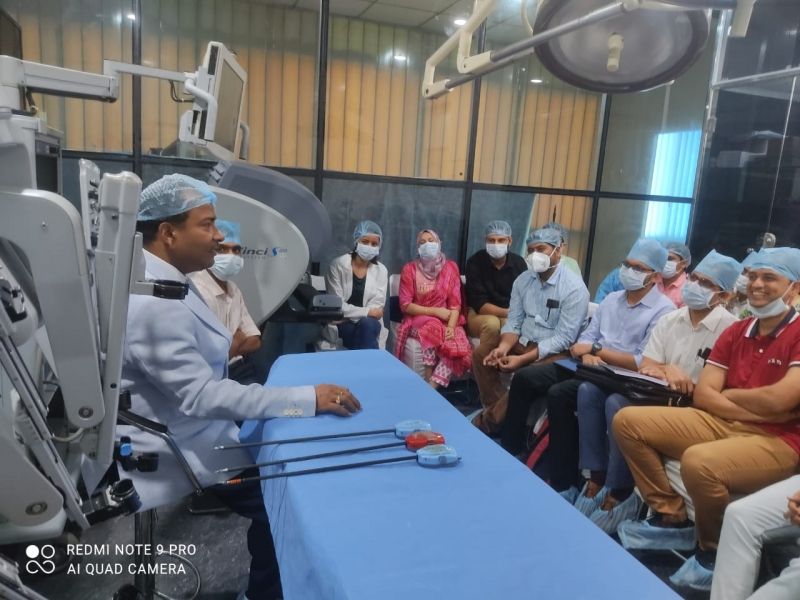
Prof. Dr. R. K. Mishra delivered a comprehensive and step-by-step explanation of the robotic surgical platform, focusing on its core components, engineering concepts, and safe clinical application.
He began with a clear overview of the Patient Cart, detailing its multi-arm architecture, degrees of freedom, trocar alignment, and the importance of correct port geometry to prevent external and internal arm collisions. Emphasis was placed on atraumatic docking, instrument reach, and maintaining optimal working angles during complex procedures.
The session then covered the Vision Cart, explaining image processing, light source integration, camera control, and system communication. Prof. Mishra elaborated on the principles of optical 3D HD imaging, including dual-lens endoscopy, depth perception, magnification, and image stability—key factors that enhance precision in fine dissection and intracorporeal suturing.
Attention was next directed to the Master Console, where the surgeon operates in an ergonomically optimized seated position. He explained motion scaling, tremor filtration, clutch mechanisms, camera control, and surgeon–robot interface design, highlighting how these features translate surgeon intent into precise instrument movement at the operative field.
A dedicated segment addressed instrument design and working principles, including wristed articulation, end-effector mechanics, energy transmission, and instrument life cycles. Prof. Mishra further explained the robotic remote sensor technology, clarifying how real-time feedback, motion transmission, and system safety checks ensure accuracy and reliability throughout the procedure.
Finally, the concept and technique of robotic docking were demonstrated in detail—covering patient positioning, port mapping, arm alignment, clearance checks, and troubleshooting. The session reinforced that proper docking is fundamental to operative efficiency, safety, and smooth workflow, especially in advanced and multiquadrant robotic surgeries.
Overall, the explanation provided a clear understanding of robotic system architecture, optical engineering, and practical docking strategy, equipping surgeons with the knowledge required for safe adoption and effective utilization of robotic surgery in modern clinical practice.
World Laparoscopy Hospital: A Hub of Contemporary Learning with Daily 8-Hour Hands-On Laparoscopic Training
In the realm of medical education and training, there are institutions that stand out as pioneers, constantly pushing the boundaries of what is possible. One such institution is the World Laparoscopy Hospital, where a contemporary event unfolds every day, featuring a remarkable 8-hour hands-on laparoscopic training program.
A Daily Revolution in Learning
At the heart of the World Laparoscopy Hospital's mission is the commitment to train the next generation of surgeons and medical professionals in the art and science of Minimal Access Surgery. What makes this institution truly exceptional is its daily 8-hour hands-on laparoscopic training program.
The Laparoscopic Revolution
Laparoscopic surgery, often referred to as minimally invasive surgery, has revolutionized the field of surgery in recent decades. Instead of large incisions, this technique involves making tiny keyhole-like openings through which a camera and surgical instruments are inserted. This results in significantly reduced patient trauma, shorter recovery times, and less post-operative pain.
The Daily Experience at World Laparoscopy Hospital
Every day at World Laparoscopy Hospital is a contemporary event in the world of medical education. Here's a glimpse into what a typical day looks like for those fortunate enough to train at this prestigious institution:
1. Intensive Training: The 8-hour hands-on laparoscopic training is an immersive experience where trainees work side by side with experienced surgeons. This hands-on approach ensures that students gain practical skills and confidence in performing laparoscopic procedures.
2. State-of-the-Art Facilities: The hospital boasts state-of-the-art facilities, equipped with the latest laparoscopic instruments and technology. Trainees have access to the same tools and equipment used in modern surgical practices around the world.
3. Expert Faculty: The training is conducted under the guidance of expert faculty members who are pioneers in the field of Minimal Access Surgery. Their wealth of knowledge and experience provides students with invaluable insights and mentorship.
4. Customized Curriculum: The training program is tailored to the specific needs and experience levels of each student. Whether you are a novice or an experienced surgeon looking to refine your skills, there is a program to suit your requirements.
5. Global Reach: World Laparoscopy Hospital attracts medical professionals from all corners of the world. This diverse group of trainees fosters cross-cultural exchanges and collaborations, enriching the learning experience.
6. Research Opportunities: Beyond the hands-on training, the hospital also serves as a hub for research and innovation in the field of Minimal Access Surgery. Trainees have the opportunity to participate in cutting-edge research projects.
Impact Beyond the Classroom
The impact of the daily 8-hour hands-on laparoscopic training at World Laparoscopy Hospital extends far beyond the classroom. Graduates of this program return to their respective countries armed with advanced skills, contributing to the global dissemination of minimally invasive surgical techniques. Patients around the world benefit from the reduced invasiveness, faster recoveries, and improved outcomes that these skilled professionals bring to their practice.
In conclusion, World Laparoscopy Hospital's commitment to daily 8-hour hands-on laparoscopic training is a testament to its dedication to excellence in medical education. By offering a world-class learning environment and fostering a culture of innovation, this institution is shaping the future of surgery, one trainee at a time. It is not just an institution; it is a beacon of hope for patients and a driving force in advancing the field of surgery.








