BASIC INFORMATION
Lecture Handout Prepared from the Teaching Session by: Dr. R. K. Mishra
SUMMARY
This lecture focused on the management of complications that are specifically associated with robotic general surgery. The speaker emphasized that the robot is only a surgical tool and that safe outcomes depend on judgment, experience, teamwork, preparation, and disciplined operative conduct. The lecture deliberately excluded complications that are common to open, laparoscopic, and robotic operations, such as anastomotic leak or bladder injury, and concentrated instead on complications related to the robotic platform.
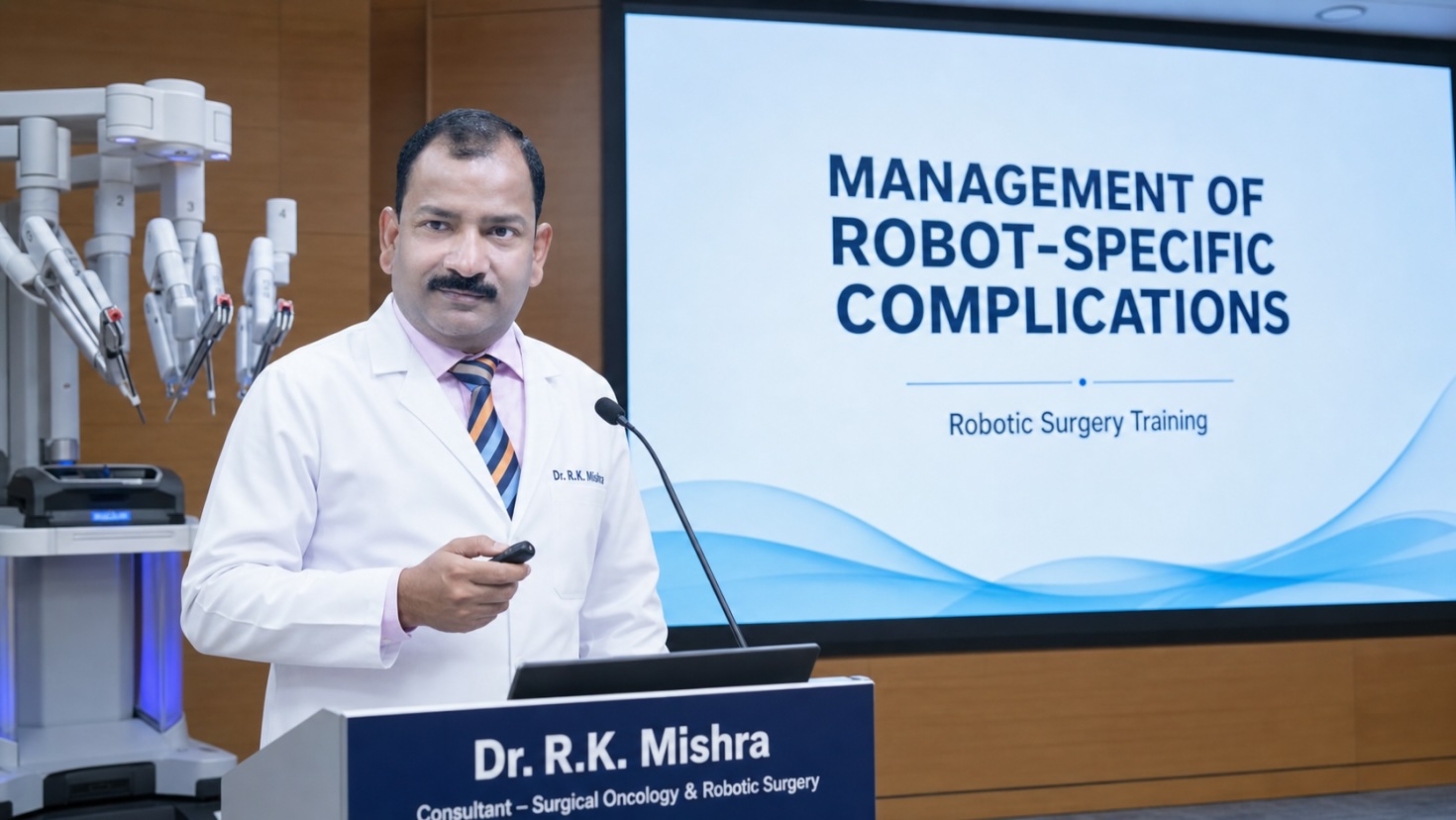
Important robotic surgery-specific challenges discussed included trocar-site hernia due to torque from docked robotic arms, loss of needles within the operative field, complications related to lack of tactile feedback, inappropriate use of energy, instrument-related injuries, and crisis management during major bleeding. The speaker stressed that robotic operations may create a false sense of empowerment, encouraging surgeons to attempt technically advanced procedures after limited exposure, including through highly edited social media videos. This tendency must be balanced by training, humility, preparation, and patient safety.
A major theme of the lecture was the need for an experienced bedside assistant and a well-coordinated operating room team. Robotic surgery requires precise communication, especially during instrument exchange, bleeding control, and conversion to open surgery. Examples were presented from cholecystectomy, right hemicolectomy, sigmoid colectomy, Whipple procedure, and median arcuate ligament release to illustrate potential hazards and the principles of correction.
The lecture concluded that complications must be studied as carefully as successful procedures. Surgeons should record and review their cases, learn from complications, understand the forces and energy characteristics of robotic instruments, maintain a broad operative view, communicate clearly with the team, and prepare for prompt conversion when necessary.
KEY KNOWLEDGE POINTS
-
The robot is a surgical tool and does not replace surgical judgment, training, or teamwork.
-
Robotic surgery-specific complications may arise from:
-
Inexperienced bedside assistance
-
Lack of tactile feedback
-
Excessive confidence in performing advanced procedures
-
Highly edited social media content
-
Attempts to justify robotic technology by compromising port placement or operative safety
-
-
Trocar-site hernia may be more common in robotic surgery due to torque from docked robotic arms.
-
Proper port placement and alignment of the remote center at the fascial level are essential.
-
Lost needles require a systematic search strategy.
-
Needle removal should be performed carefully, one suture at a time, under direct visualization.
-
Lack of tactile feedback may cause excessive traction, tissue avulsion, clip displacement, or thermal injury.
-
Surgeons must understand the grasping force of robotic instruments.
-
Energy sources must be used with full awareness of thermal spread and device activation.
-
Two active energy sources should be avoided, especially during long operations or when a trainee is at the console.
-
Major bleeding during robotic surgery requires calm behavior, clear communication, suction control, pressure, suturing skill, and readiness for conversion.
-
Conversion to open surgery requires deliberate communication, ongoing pressure on the bleeding site, and coordinated action with anesthesia.
-
Surgeons should study operative complications, not only successful edited videos.
INTRODUCTION
Robotic surgery has expanded the scope of minimally invasive general surgery by improving dexterity, suturing capability, visualization, and ergonomics. It has enabled surgeons to perform complex procedures robotically, including revisional operations, recurrent hernia repairs, colorectal resections, foregut procedures, and pancreatic surgery. However, the robotic platform introduces specific hazards that differ from conventional laparoscopy.
Unlike standard laparoscopic surgery, robotic surgery involves docked arms, remote centers, limited tactile feedback, console separation from the patient, dependence on a bedside assistant, and a more complex operating room workflow. These characteristics can produce complications that are either unique to robotic surgery or more likely to occur in robotic procedures.
The lecture emphasized that the surgeon must remain a lifelong student. Hindsight may make complications appear obvious, but real-time recognition and management require training, preparation, humility, and teamwork. The focus should not be on blaming the technology but on understanding how to use it safely.
LEARNING OBJECTIVES
-
Understand the major complications that are particularly associated with robotic general surgery.
-
Describe preventive strategies for trocar-site hernia, lost needles, energy injury, and instrument-related trauma.
-
Apply systematic principles for managing intraoperative crises, including bleeding and conversion to open surgery.
-
Recognize the importance of team communication, experienced bedside assistance, and case review in improving robotic surgical safety.
CORE CONTENT
1. Conceptual Approach to Robotic Surgery Complications
1.1 Robot as a Surgical Tool
The speaker emphasized that the robotic platform is only a tool. It can enhance minimally invasive surgery but cannot compensate for poor judgment, inadequate preparation, poor team communication, or lack of operative experience. Safe robotic surgery requires the same fundamental surgical principles as open or laparoscopic surgery, with additional attention to platform-specific risks.
1.2 Complications Excluded from the Discussion
The lecture did not focus on complications that may occur in any operative approach, such as:
-
Anastomotic leak
-
Bladder injury
-
General operative injuries unrelated to the robotic platform
Instead, the emphasis was placed on complications that are particularly related to robotic surgery.
1.3 Causes of Robot-Specific Complications
The following causes were highlighted:
-
Inexperienced bedside assistant
-
Lack of tactile feedback
-
Surgeon overconfidence due to the technical capability of the robot
-
Attempting complex procedures after watching limited online videos
-
Reliance on highly edited social media content
-
Pressure to justify robotic technology to hospital administration
-
Unsafe reduction in port number or suboptimal port positioning in difficult cases
2. Trocar-Site Hernia in Robotic Surgery
2.1 Mechanism
Trocar-site hernia may be seen more frequently in robotic surgery compared with conventional laparoscopy because of constant torque generated by docked robotic arms. Once the arms are docked, mechanical stress can enlarge the fascial opening.
2.2 Preventive Principles
The speaker emphasized the following preventive measures:
-
After docking, the robotic arms should be “burped” to the skin until skin recoil is observed.
-
The remote center of the port should be positioned at the level of the fascia.
-
Midline trocar sites should be avoided when possible.
-
Even 8 mm trocar sites should be used cautiously in the midline unless specimen extraction is planned.
-
Trocar-site closure should be considered when larger or long trocars are used in a way that places the remote center at the skin or subcutaneous tissue rather than at the fascia.
2.3 Importance of Trocar Diameter
The speaker noted that the outer diameter of robotic trocars is larger than the nominal internal size:
-
A 12 mm trocar may have an outer diameter of approximately 1.5 cm.
-
An 8 mm trocar may have an outer diameter of approximately 1.1 cm.
This is clinically relevant because a larger fascial defect may increase the risk of trocar-site hernia.
2.4 Long 12 mm Trocar and Obese Patients
In patients with large body habitus or large thighs, a long 12 mm trocar may be used to prevent robotic arm collision. However, the remote center may then lie at the skin or subcutaneous level rather than at the fascia. In such cases, the port site should be closed to reduce the risk of trocar-site hernia.
3. Lost Needles During Robotic Surgery
3.1 Causes
Lost needles are a significant problem in robotic surgery. Causes discussed included:
-
Inexperienced assistant introducing a large needle through an 8 mm trocar without proper handling
-
Failure to observe the needle during removal
-
Placement of multiple needles in the abdominal cavity to save time
-
Inadequate attention to needle position during instrument exchange
3.2 Proper Needle Removal Technique
The recommended principles were:
-
Use a needle driver for removal.
-
Avoid using a bowel grasper for needle removal.
-
Remove one suture at a time.
-
Be especially careful when removing sutures of different calibers.
-
Leave a tail long enough for the needle to move freely.
-
Do not place the suture at the crutch of the instrument.
-
Block the area during removal so that the needle does not fly back into the abdomen.
-
Watch the needle continuously during withdrawal.
3.3 Stepwise Management of a Lost Needle
The lecture described a systematic approach:
-
Examine the surgical field.
-
Confirm that the needle count is incorrect.
-
Ask the scrub technician to examine the back table.
-
Inspect the floor.
-
Examine the trocar site.
-
Disassemble the trocar if necessary, because the needle may be trapped beneath the plastic component.
-
Consider fluoroscopy of the trocar site.
-
Examine the suction device.
-
If the needle is smaller than 4-0, use intraoperative fluoroscopy or X-ray.
-
If still not found, obtain postoperative imaging.
-
If imaging does not reveal the needle, follow the patient appropriately.
3.4 Clinical Scenario: Lost Needle During Hiatal Hernia Repair
A case was described involving a patient undergoing hiatal hernia repair after knee replacement, with volvulus requiring repair. Multiple needles were present in the abdominal cavity. Near the end of a three-hour operation, the team identified a missing needle.
The surgeon searched robotically, then undocked and searched laparoscopically. The spleen and pancreas were mobilized laterally to medially, but the needle was not found. Fluoroscopy showed the needle in the left upper quadrant, but it could not be localized within the abdominal cavity. A VATS procedure was attempted because the surgeon had thoracic privileges, but the lungs were inflated and no target was seen. The case illustrated the complexity and frustration of managing lost needles at the end of prolonged robotic operations.
4. Lack of Tactile Feedback and Instrument-Related Injury
4.1 Importance of Tactile Feedback
Robotic surgery lacks conventional tactile feedback. The surgeon must therefore rely heavily on visual cues to judge tissue tension, traction, grasping force, clip security, and energy effect.
4.2 Cholecystectomy Example: Clip Displacement and Cystic Duct Injury
During robotic cholecystectomy, after achieving the critical view of safety, clips were applied to the cystic duct and cystic artery. A hook was used, and energy was applied close to the clip. Excessive tension was placed on the cystic duct during transection. The clips fell off, and the cystic duct was avulsed from the common bile duct.
This example illustrated two important hazards:
-
Inappropriate energy application near clips
-
Excessive traction due to lack of tactile feedback
4.3 Right Hemicolectomy Example: Wrong Arm Activation
During a robotic right hemicolectomy, the team was creating enterotomy and colotomy for stapled anastomosis. The patient was on Plavix, and a white stapler load was used instead of the speaker’s usual blue load. During activation, the wrong arm was activated, and the bowel was burned. The injured area was cut out and repaired, and the patient did well.
This example emphasized the risk of wrong instrument or wrong arm activation, especially when energy devices are present.
4.4 Understanding Grasping Force
Surgeons should understand the grasping force of robotic instruments. The speaker referred to manufacturer-provided charts comparing instruments such as Maryland forceps, Force Bipolar, and Long Tip instruments. The surgeon should select instruments appropriately and avoid traumatic handling.
A specific example was given:
-
Do not run the bowel with a ProGrasp instrument.
4.5 Development of Visual Judgment
Because tactile feedback is absent, visual judgment must be developed. The speaker described training with fine sutures, such as breaking 4-0 and 6-0 sutures, to improve visual recognition of excessive force.
4.6 Avoidance of Tunnel Vision
The surgeon should avoid focusing only on the immediate operative target. A narrow “tunnel view” can allow excessive traction or distortion of adjacent structures. For example, during cholecystectomy, traction on the infundibulum may cause bowing of the common bile duct. The surgeon must periodically widen the field of view and assess the entire screen.
5. Energy-Related Complications
5.1 Principles of Energy Safety
The speaker emphasized the importance of understanding:
-
Energy spread
-
Differences between monopolar and bipolar energy
-
Device-specific behavior
-
Safe activation of energy instruments
The speaker recommended familiarity with structured education on the fundamental use of surgical energy.
5.2 Avoidance of Multiple Energy Sources
The use of two energy sources should be avoided, particularly:
-
During long operations
-
When a trainee is operating at the console
-
During complex or critical steps
This reduces the risk of wrong arm activation and unintended thermal injury.
6. Bleeding During Robotic Surgery
6.1 Teamwork as the Foundation of Bleeding Control
Robotic bleeding control depends on teamwork. A skilled bedside assistant, clear communication, and calm behavior are essential. The surgeon at the console is physically separated from the patient; therefore, the assistant’s role becomes critical.
6.2 Clear Communication During Instrument Exchange
Vague commands should be avoided. The speaker specifically discouraged statements such as:
-
“I am ready.”
Instead, communication should be specific:
-
“Remove arm one, the Maryland.”
-
The bedside assistant should confirm: “Arm one, the Maryland is coming out.”
-
The console surgeon should acknowledge and agree before removal.
6.3 Warning the Team Before Critical Steps
Before a high-risk step, the surgeon should alert the team:
-
“This is a critical point of the procedure. Please be aware.”
This prepares the team for bleeding, instrument exchange, suction, suturing, or conversion.
7. Bleeding Case Examples
7.1 Sigmoid Colectomy: IMA Bleeding and Aortic Injury
During sigmoid colectomy, the surgeon was dissecting near the inferior mesenteric artery while attempting to retrieve an additional lymph node near the aorta. The speaker emphasized that if an oncologic resection has already achieved an adequate lymph node yield, there is no need to pursue an extra node at excessive risk.
Bleeding occurred from the IMA region. A vessel sealer was used repeatedly, but bleeding worsened, and the IMA was avulsed from the aorta, creating a hole in the aorta.
Management principles included:
-
Placement of an additional trocar for suction
-
Calm communication with the team
-
Control with the left robotic arm
-
Request for removal of the right arm
-
Recognition of assistant error when the wrong arm was removed
-
Regaining control
-
Placement of a suture to control bleeding
The patient did not require blood transfusion and did well.
7.2 Whipple Procedure: Bleeding from the Uncinate Process Region
During a Whipple procedure, bleeding occurred from a branch while dissecting the uncinate process. The importance of an experienced bedside assistant was emphasized. Subtle movement between the right and left arms helped rotate the portal vein and improve exposure.
Key points included:
-
Be prepared for bleeding during complex procedures.
-
Have a 12 cm or 15 cm Prolene suture ready.
-
Use suction carefully to clear the field.
-
Avoid excessive suction that evacuates pneumoperitoneum.
-
Use suturing, including figure-of-eight repair, when appropriate.
-
Maintain calm and coordinated action.
7.3 Whipple Procedure: Bleeding from the First Jejunal Branch
Another Whipple case demonstrated bleeding from the first jejunal branch. The assistant provided exposure and retraction while the surgeon sutured. A short suture with a clip at the end was used. The patient did well and did not require transfusion.
7.4 Use of Lapra-Ty or Hem-o-lok on Sutures
The speaker noted that a Lapra-Ty or Hem-o-lok may be used at the end of a suture. However, when using 4-0 or finer suture, a Hem-o-lok will not hold adequately. A Lapra-Ty should be used for finer sutures.
8. Conversion to Open Surgery
8.1 Clinical Scenario: Aortic Injury During Median Arcuate Ligament Release
The speaker described a case from fellowship involving median arcuate ligament release. While dissecting near the left gastric artery, excessive energy was applied behind the hook, resulting in a burn injury to the aorta. The injury was initially not recognized. The patient then developed bleeding from the aorta. Within approximately two minutes, blood pressure dropped from 120 mmHg to the 60s, and epinephrine was required.
This case illustrated the need for immediate recognition, communication, and conversion when bleeding cannot be controlled robotically.
8.2 Principles of Conversion to Open Surgery
The speaker emphasized that conversion during robotic surgery includes an additional step because the robot is docked. The following sequence was recommended:
-
Communicate clearly to the entire team that conversion to open surgery is required.
-
Inform anesthesia that the situation is critical.
-
Request blood in the room.
-
Apply pressure to the bleeding site with a sponge.
-
Do not leave the bleeding site uncontrolled while undocking.
-
Maintain pressure laparoscopically while assistants undock the robot.
-
Open the abdomen with a knife.
-
Pack with sponges.
-
Allow anesthesia to catch up with resuscitation and blood administration.
-
Place retractors after initial control and resuscitation.
-
Obtain exposure and perform definitive repair.
8.3 Pneumoperitoneum During Bleeding
The speaker stated that evacuation of pneumoperitoneum is questionable and depends on the type of bleeding. Pneumoperitoneum may sometimes help reduce bleeding, particularly in certain venous bleeding situations. The decision should be individualized.
SURGICAL PEARLS
-
Treat the robot as a tool, not as a substitute for judgment.
-
Do not attempt complex robotic operations solely after watching edited online videos.
-
Burp robotic arms after docking to reduce torque at the port site.
-
Ensure the remote center is at the fascial level.
-
Avoid midline trocar placement when possible.
-
Close trocar sites when port size, location, or trocar type increases hernia risk.
-
Remove one needle at a time and watch it continuously.
-
Do not use a bowel grasper to remove a needle.
-
Keep a sufficiently long suture tail during needle removal.
-
Do not place the suture at the crutch of the instrument.
-
Develop visual judgment to compensate for the absence of tactile feedback.
-
Do not run bowel with a ProGrasp instrument.
-
Avoid tunnel vision; periodically widen the operative view.
-
Understand the grasping force of each robotic instrument.
-
Understand the spread and behavior of monopolar and bipolar energy.
-
Avoid two active energy sources, especially during long cases or training cases.
-
Use precise verbal commands during instrument exchange.
-
Alert the team before critical operative steps.
-
Keep appropriate sutures ready during high-risk procedures.
-
During bleeding, use enough suction to clear the field but not enough to lose pneumoperitoneum unnecessarily.
-
When conversion is required, communicate clearly, maintain pressure, undock efficiently, and open with control.
ANESTHETIC AND PHYSIOLOGICAL CONSIDERATIONS
The lecture discussed anesthetic implications mainly in the context of major bleeding and conversion to open surgery.
During uncontrolled hemorrhage, anesthesia must be informed immediately. The surgeon should clearly state that the team is in trouble and that conversion to open surgery is required. Blood should be brought into the room. In the described aortic injury case, the patient’s blood pressure dropped rapidly from 120 mmHg to the 60s, and epinephrine was required.
The speaker emphasized that pressure should be maintained on the bleeding site while the robot is being undocked and while access to the abdomen is being obtained. This allows anesthesia time to begin resuscitation and blood administration.
The role of pneumoperitoneum during bleeding was discussed as variable. It may help reduce bleeding in some circumstances, especially venous bleeding, but the decision to evacuate or maintain pneumoperitoneum depends on the clinical situation.
COMPLICATIONS AND THEIR MANAGEMENT
Intraoperative Complications
Trocar-Site Fascial Enlargement
Mechanism: Constant torque from docked robotic arms.
Management and prevention:
-
Burp arms after docking.
-
Place remote center at fascial level.
-
Avoid midline port sites where possible.
-
Close high-risk port sites.
Lost Needle
Management:
-
Confirm incorrect count.
-
Search operative field.
-
Examine back table and floor.
-
Inspect and disassemble trocar.
-
Check suction device.
-
Use fluoroscopy or X-ray when necessary.
-
Obtain postoperative imaging if not found.
Clip Displacement and Ductal Injury
Mechanism: Excessive traction and energy applied close to clips.
Prevention:
-
Use proper energy technique.
-
Avoid excessive traction.
-
Maintain a wide field of view.
-
Rely on visual cues.
Thermal Injury from Wrong Arm Activation
Mechanism: Activation of incorrect instrument or energy source.
Prevention:
-
Avoid multiple active energy sources.
-
Communicate clearly.
-
Maintain awareness of instrument location and function.
Major Vascular Bleeding
Management:
-
Stay calm.
-
Communicate clearly.
-
Obtain suction.
-
Apply direct control or pressure.
-
Use prepared sutures.
-
Ensure assistant coordination.
-
Convert to open surgery if control is inadequate.
Early Postoperative Complications
The lecture did not describe specific early postoperative complications in detail. The cases described were managed intraoperatively, and the speaker repeatedly noted that the patients did well.
Late Postoperative Complications
Trocar-Site Hernia
Risk factors discussed:
-
Robotic arm torque
-
Larger outer diameter of trocar
-
Midline port placement
-
Improper remote center position
-
Use of long trocars with remote center at skin or subcutaneous level
-
Failure to close high-risk port sites
Prevention:
-
Proper port placement
-
Correct remote center positioning
-
Port closure when indicated
MEDICOLEGAL AND PATIENT SELECTION CONSIDERATIONS
Patient safety requires appropriate case selection, humility, preparation, and honest assessment of surgeon and team capability. The lecture highlighted several important medicolegal and decision-making principles:
-
Surgeons should not allow social media videos to create false confidence.
-
Online surgical videos are often highly edited and may not show complications.
-
Surgeons should learn from complications, not only from ideal outcomes.
-
The pressure to justify robotic technology should not compromise safety.
-
Avoid reducing port number in difficult cases merely to appear efficient or cost-conscious.
-
A trained bedside assistant is essential for safe robotic surgery.
-
Clear communication is a safety requirement, not a courtesy.
-
Before high-risk cases, appropriate instruments, sutures, blood availability, and conversion strategy should be planned.
-
Conversion to open surgery should not be delayed when bleeding cannot be controlled robotically.
-
Surgeons should record and review their cases to identify errors and improve performance.
SUMMARY AND TAKE-HOME MESSAGES
-
The robot is only a tool; safe robotic surgery depends on judgment, teamwork, training, and preparation.
-
Robotic surgery-specific complications include trocar-site hernia, lost needles, lack of tactile feedback injuries, energy injuries, wrong arm activation, and crisis-related team errors.
-
Clear communication with the bedside assistant is essential during instrument exchange and bleeding control.
-
Surgeons must understand robotic instrument forces, energy spread, and the limitations of visual-only feedback.
-
Major bleeding requires calm leadership, pressure, suction control, prepared sutures, anesthesia communication, and timely conversion if needed.
-
Surgeons should study complications carefully and review their own operative videos to improve safety.
MULTIPLE CHOICE QUESTIONS (MCQs)
1. Which of the following was the main focus of the lecture?
A. Management of all complications in general surgery
B. Management of complications specific to robotic general surgery
C. Management of postoperative infections after robotic surgery
D. Comparison of open and laparoscopic surgery
Correct Answer: B
2. According to the lecture, the robot should be regarded primarily as:
A. A replacement for surgical judgment
B. A tool to assist surgical practice
C. A method to avoid teamwork
D. A guarantee of safe surgery
Correct Answer: B
3. Which factor was identified as a cause of robot-specific complications?
A. Excessive tactile feedback
B. Inexperienced bedside assistant
C. Absence of pneumoperitoneum
D. Use of open instruments
Correct Answer: B
4. Trocar-site hernia may be more common in robotic surgery because of:
A. Reduced visualization
B. Constant torque from docked robotic arms
C. Absence of suturing
D. Increased bowel handling only
Correct Answer: B
5. After docking robotic arms, the surgeon should ensure that the arms are:
A. Left under maximum tension
B. Burped to the skin until skin recoil occurs
C. Removed immediately
D. Positioned without regard to the port site
Correct Answer: B
6. The remote center of a robotic port should ideally be positioned at the level of the:
A. Skin
B. Subcutaneous fat
C. Fascia
D. Peritoneal fluid
Correct Answer: C
7. The outer diameter of a 12 mm robotic trocar was described as approximately:
A. 8 mm
B. 10 mm
C. 1.5 cm
D. 3 cm
Correct Answer: C
8. Which of the following is a recommended technique for robotic needle removal?
A. Remove multiple needles simultaneously
B. Use a bowel grasper for rapid removal
C. Use a needle driver and remove one suture at a time
D. Place the suture at the crutch of the instrument
Correct Answer: C
9. When a needle is lost, which step should be included in the search?
A. Ignore the count discrepancy
B. Disassemble and examine the trocar site
C. Immediately close the abdomen without searching
D. Avoid imaging under all circumstances
Correct Answer: B
10. For a lost small needle, the lecture recommended considering:
A. Immediate discharge
B. Intraoperative fluoroscopy or X-ray
C. Blind clamping
D. Routine bowel resection
Correct Answer: B
11. The cystic duct complication shown during cholecystectomy was related to:
A. Excessive tactile feedback
B. Energy near clips and excessive traction
C. Lack of clipping
D. Failure to create pneumoperitoneum
Correct Answer: B
12. Which instrument-related recommendation was made in the lecture?
A. Run bowel with a ProGrasp instrument
B. Avoid understanding instrument forces
C. Know the grasping force of robotic instruments
D. Use the strongest grasper for all tissues
Correct Answer: C
13. To compensate for lack of tactile feedback, the surgeon should rely on:
A. Visual cues
B. Blind traction
C. Sound alone
D. Increased energy settings
Correct Answer: A
14. During cholecystectomy, excessive traction on the infundibulum may cause bowing of the:
A. Splenic artery
B. Common bile duct
C. Inferior vena cava
D. Ureter
Correct Answer: B
15. The speaker advised avoiding two energy sources especially in:
A. Short diagnostic procedures only
B. Long cases or when a trainee is at the console
C. Cases without assistants
D. Open surgery only
Correct Answer: B
16. During robotic bleeding, communication should be:
A. Vague and rapid
B. Specific, with arm and instrument identified
C. Avoided to reduce stress
D. Limited to the console surgeon only
Correct Answer: B
17. In the sigmoid colectomy bleeding example, excessive pursuit of an additional lymph node near the aorta contributed to injury involving the:
A. Inferior mesenteric artery region
B. Cystic duct
C. Portal vein bifurcation only
D. Gastric fundus
Correct Answer: A
18. During Whipple-related bleeding, the speaker recommended having which suture ready?
A. 12 cm or 15 cm Prolene suture
B. Absorbable skin suture only
C. No suture, only clips
D. Braided skin stitch only
Correct Answer: A
19. If a Hem-o-lok is used at the end of a suture, it may not hold adequately when the suture is:
A. 0 silk
B. 2-0 Prolene
C. 4-0 or finer
D. Larger than 1-0
Correct Answer: C
20. During conversion to open surgery for uncontrolled robotic bleeding, the first essential action is to:
A. Quietly undock without informing the team
B. Clearly communicate the need for conversion and alert anesthesia
C. Remove all instruments without pressure
D. Evacuate pneumoperitoneum in every case
Correct Answer: B
MOTIVATIONAL MESSAGE FROM DR. R. K. MISHRA
“Mastery in surgery is not proven by avoiding difficult moments, but by meeting them with preparation, discipline, calm judgment, and respect for patient safety.”
My best wishes to all postgraduate surgeons and gynecologists. Continue to learn from every case, every error, and every challenge with humility and dedication.