BASIC INFORMATION
Date & Time: 16 June 2026, 16:39:13 Indian Standard Time
Lecture Handout Prepared from the Teaching Session by: Dr. R. K. Mishra
SUMMARY
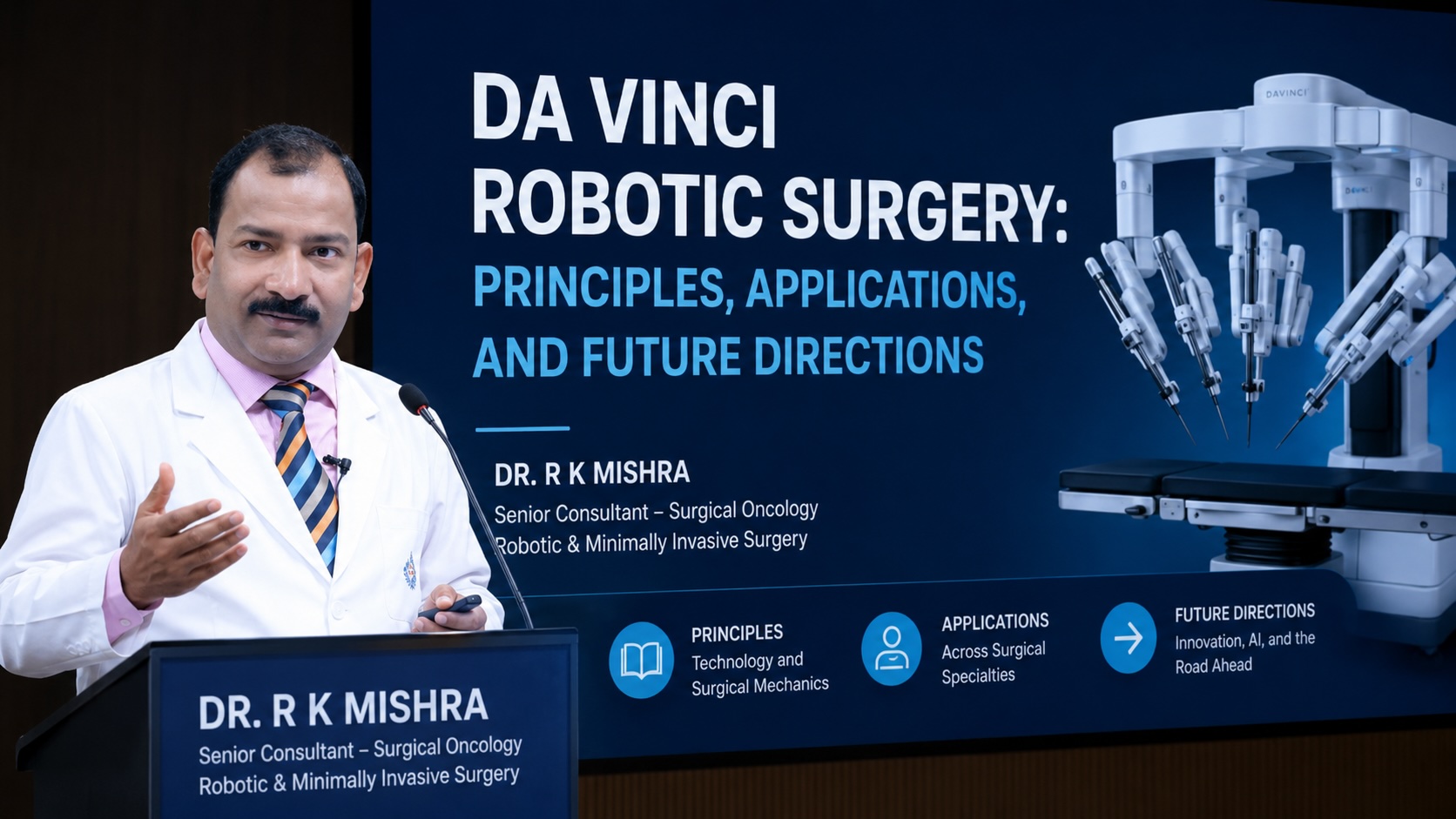
This lecture by Dr. R. K. Mishra provides a comprehensive academic review of da Vinci robotic surgery, covering its historical evolution, terminology, system components, models, operative principles, clinical applications, advantages, docking requirements, safety concerns, limitations, operating room practicalities, tele-surgery, and future directions. The lecture begins with the origin of the word “robot,” derived from the work of Karel Čapek and meaning “forced labor,” and clarifies that the da Vinci system is not a true autonomous robot but a master-slave manipulator controlled entirely by the surgeon.
The lecture reviews the development of the da Vinci system from United States military research, its commercialization by Intuitive Surgical, the legal conflict with Computer Motion and the Zeus robotic system, and the eventual merger that left da Vinci as the dominant FDA-approved robotic surgical platform discussed in the session. The major components of the system are described: the surgeon’s console, vision cart, and patient-side cart. Different models, including Standard/S, SHD, Si, and Xi, are compared in relation to imaging, arm design, dual-console capability, service support, and compactness.
Dr. Mishra explains the major advantages of robotic surgery, including true binocular three-dimensional vision, motion scaling, wrist articulation, tremor filtration, remote sensing technology, improved ergonomics, wider stereoscopic field of view, haptic warning systems, teleproctoring, telementoring, and increased degrees of freedom. The lecture also emphasizes limitations, particularly the absence of true tactile feedback, high cost, dependence on maintenance contracts, limited instrument life, need for a skilled bedside assistant, docking time, larger operating room requirement, limited training access, and lack of clear cost-effectiveness for simple laparoscopic procedures.
Clinical applications discussed include radical prostatectomy, hysterectomy, prolapse repair, tubal reversal, fistula repair, myomectomy, cholecystectomy, appendectomy, ovarian cystectomy, gastric bypass, gastrostomy, Nissen fundoplication, sleeve gastrectomy, and selected cardiac procedures. Radical prostatectomy is highlighted as the most popular and rewarding application because of the difficulty of cystourethral anastomosis in a deep, narrow pelvis. Robotic hysterectomy is also emphasized as highly suitable because of improved suturing and instrument articulation. Sleeve gastrectomy is discussed more cautiously because it remains primarily a stapler-based procedure.
The lecture gives detailed principles of docking, including the baseball diamond concept, avoidance of ipsilateral port positioning, remote sensor placement in the abdominal wall, appropriate instrument spacing, manipulation angle, azimuth angle, elevation angle, and procedure-specific docking direction. Practical operative demonstrations include robotic appendectomy, ovarian cystectomy, and cholecystectomy, emphasizing cost-conscious instrumentation, intracorporeal suturing, proper knot formation, tissue handling, and safe energy use.
Safety issues discussed include robotic arm collision, instrument swording, patient injury, electrosurgical complications, gas leakage, bowel perforation, lack of automatic clinical complication detection, and the need for team vigilance. The lecture also discusses tele-surgery and globalization of surgery, including the first transatlantic robotic cholecystectomy experiment between New York and Strasbourg in September 2001, with latency identified as the major barrier. The future of robotic surgery is described in terms of single-port systems, internal locomotion robots, microrobots, nanorobots, and possible molecular surgery.
KEY KNOWLEDGE POINTS
-
The word “robot” was derived from the work of Karel Čapek and means “forced labor.”
-
The da Vinci surgical system is technically a master-slave manipulator, not an autonomous robot.
-
A true robot performs preprogrammed or autonomous tasks, whereas da Vinci only translates surgeon movements.
-
The da Vinci system originated from United States military research and was commercialized by Intuitive Surgical.
-
Computer Motion marketed the Zeus robotic system and later merged with Intuitive Surgical after legal conflict.
-
AESOP was a voice-command camera-holding robot but had limited popularity.
-
The three major components of the da Vinci system are the surgeon’s console, vision cart, and patient-side cart.
-
The surgeon operates from an unsterile console and sees a true binocular three-dimensional image.
-
The vision cart contains the assistant monitor, camera processor, light source, insufflator, and energy sources.
-
The patient-side cart contains robotic arms that execute movements commanded by the surgeon.
-
Models discussed include Standard/S, SHD, Si, and Xi.
-
The Si model introduced dual-console compatibility.
-
The Xi model has a compact design with four arms emerging from a single stem.
-
Robotic surgery offers three-dimensional vision, motion scaling, tremor filtration, wrist articulation, ergonomic comfort, remote sensing, and seven or more degrees of movement.
-
Robotic surgery lacks true tactile feedback and relies on visual cues and haptic warnings.
-
Haptic feedback is a visual or auditory substitute for tactile sensation, not true touch.
-
Teleproctoring and telementoring are possible through console connectivity.
-
Radical prostatectomy is the most popular global application of da Vinci robotic surgery.
-
Robotic surgery is particularly useful in deep, narrow operative fields requiring precise suturing.
-
Cystourethral anastomosis after radical prostatectomy is facilitated by robotic articulation.
-
Robotic hysterectomy is valuable because suturing, vault closure, uterine artery control, and angled dissection are easier.
-
Sleeve gastrectomy has limited robotic advantage because it remains primarily stapler-dependent.
-
Robotic cholecystectomy, appendectomy, and ovarian cystectomy are technically possible but often not cost-effective compared with standard laparoscopy.
-
Proper docking is essential to prevent arm collision, instrument malfunction, patient injury, and error messages.
-
The baseball diamond concept remains applicable to robotic port placement.
-
Robotic surgery does not favor ipsilateral port placement.
-
Ports should generally be placed approximately 18 to 20 cm from the target.
-
The remote sensing line of the cannula must lie within the abdominal wall.
-
The telescope should be placed between the working instruments.
-
Manipulation angle may be 60 to 90 degrees; azimuth angle should be 30 to 45 degrees.
-
Robotic instruments should be spaced at least 10 cm apart.
-
Robotic instruments are expensive and usually limited to 10 uses.
-
Instruments contain electronic chips that allow recognition and use counting.
-
Comprehensive maintenance contracts and internet connectivity are essential for continued system function.
-
Tele-surgery is limited mainly by transmission delay; approximately 137 milliseconds or less was stated as necessary for safe remote surgery.
-
Direct satellite connectivity may improve future tele-surgery.
-
The robot cannot detect clinical complications such as bowel perforation.
-
Active electrode monitoring may detect inappropriate current flow due to direct or capacitive coupling.
-
Future developments may include single-port robots, internal locomotion robots, microrobots, nanorobots, and molecular surgery.
-
Technology is neutral; its value depends on ethical, disciplined, patient-centered use.
INTRODUCTION
Robotic surgery is an advanced form of minimally invasive surgery in which the surgeon operates from a console while robotic arms manipulate instruments through ports placed in the patient. It was developed to overcome several limitations of conventional laparoscopy, including two-dimensional vision, restricted instrument movement, fulcrum-related movement reversal, tremor transmission, poor ergonomics, and difficulty with suturing in deep or narrow operative fields.
The da Vinci robotic surgical system offers enhanced visualization, wristed instruments, motion scaling, tremor filtration, remote center technology, and improved surgeon comfort. These features make it particularly valuable for procedures requiring precise dissection, deep pelvic access, and complex intracorporeal suturing, such as radical prostatectomy, robotic hysterectomy, tubal recanalization, myomectomy, fistula repair, and pelvic reconstructive procedures.
However, robotic surgery is not automatically superior for all operations. Dr. Mishra emphasizes that surgeons must apply robotic technology judiciously, considering patient benefit, cost, training, operating room logistics, instrument limitations, assistant skill, and safety. The robot enhances the surgeon’s mechanical capability but does not replace surgical judgment, anatomical knowledge, or responsibility for complications.
LEARNING OBJECTIVES
-
To understand the historical development and correct terminology of da Vinci robotic surgery.
-
To identify the major components and models of the da Vinci robotic system.
-
To explain the advantages of robotic surgery over conventional laparoscopy.
-
To recognize limitations such as lack of tactile feedback, cost, instrument life, and assistant dependency.
-
To describe the principles of robotic docking, port placement, remote center positioning, and instrument alignment.
-
To understand major clinical applications in urology, gynecology, general surgery, bariatric surgery, and cardiac surgery.
-
To review operative principles demonstrated in robotic appendectomy, ovarian cystectomy, cholecystectomy, hysterectomy, prostatectomy, and sleeve gastrectomy.
-
To understand safety concerns related to robotic arms, electrosurgery, gas leakage, bowel injury, and team vigilance.
-
To explain teleproctoring, telementoring, tele-surgery, and the importance of transmission latency.
-
To appreciate future developments including single-port robots, internal locomotion robots, microrobots, nanorobots, and molecular surgery.
CORE CONTENT
1. Historical Background and Terminology
1.1 Origin of the Word Robot
The word “robot” was introduced through the literary work of Karel Čapek, a Czech writer. It means “forced labor.” Dr. Mishra also referred to early cultural representation of artificial humans in the 1926 movie Metropolis, in which actors wore metallic costumes and moved like machines because modern animation technology was unavailable.
1.2 da Vinci as a Master-Slave Manipulator
Although commonly called a robot, the da Vinci surgical system is technically not a true robot. A true robot should perform preprogrammed tasks independently or repeatedly. The da Vinci system does not operate autonomously. It translates the surgeon’s hand movements at the console into precise movements inside the patient.
In this system:
-
The surgeon is the master.
-
The machine is the slave.
-
The system performs only what the surgeon commands.
-
The surgeon remains responsible for every operative movement and decision.
2. Development of the da Vinci System
2.1 Military Origin and Commercialization
The technology behind da Vinci was initially associated with United States military research, with the concept of allowing surgeons to treat battlefield victims remotely. However, the system was not sufficiently mobile and could not perform autonomous programmed work. The technology was later commercialized by Intuitive Surgical.
2.2 Computer Motion, Zeus, and Legal Conflict
Computer Motion marketed the Zeus robotic system and filed a legal case against Intuitive Surgical, alleging infringement and copying of technology. Between 2000 and 2003, both companies were affected by court restrictions. In 2003, Computer Motion and Intuitive Surgical merged, and Zeus was withdrawn from the market.
2.3 AESOP Robot
AESOP was a voice-command camera-holding robot. It could respond to commands such as close-up, panoramic movement, right, left, and tilt. However, it was not widely popular because it only held the camera, whereas a human camera assistant can interpret the operative field and anticipate surgical needs.
3. Components of the da Vinci System
3.1 Surgeon’s Console
The surgeon sits at the console in an unsterile zone. The console provides true three-dimensional binocular vision without requiring special glasses. The surgeon uses master controllers for hand movements and foot controls for camera, clutch, monopolar, and bipolar energy activation. Gloves are not required and should not be worn at the console because they may restrict fine hand movement.
3.2 Vision Cart
The vision cart contains the assistant monitor and equipment such as:
-
Camera
-
Processor
-
Light source
-
Insufflator
-
Electrosurgical generators
-
Harmonic energy source
-
Plasma kinetic or other energy systems
The assistant, anesthetist, and operating room staff view the procedure on the vision cart monitor, usually in two dimensions.
3.3 Patient-Side Cart
The patient-side cart contains the robotic arms that manipulate the instruments within the patient. The arms execute movements commanded by the surgeon from the console.
4. Models of the da Vinci System
4.1 Standard and S Models
The older Standard/S models had black arms, visible components, CRT monitors, and relatively inferior image quality. A fourth arm could be added by request. Dr. Mishra noted that service support for the S model was expected to stop after December 2015, making purchase of such systems inadvisable.
4.2 SHD Model
The SHD model introduced high-definition imaging, modular design, four arms, and a 16:9 wide-screen view.
4.3 Si Model
The Si model introduced dual-console compatibility. Two surgeons may work through two consoles, allowing more effective control of four robotic arms. With a single console, the surgeon can control only two active arms at a time and must switch between arms, leaving inactive instruments in a fixed position.
4.4 Xi Model
The Xi model was described as recently launched around 2015. It has a more compact design, with four arms emerging from a single stem. This reduces space requirements compared with earlier bulkier models. At the time discussed, no Xi model was present in India.
5. Maintenance, Software, and Internet Connectivity
5.1 Comprehensive Maintenance Contract
A comprehensive maintenance contract is essential for continued use. Dr. Mishra mentioned an annual cost of approximately 75 lakh rupees, with possible negotiation. If the contract expires, the system displays a warning and may become unusable.
5.2 Software Updates and Preventive Maintenance
The system must remain connected to the internet for software updates and preventive maintenance. The company can detect faults, such as a loose screw, and send engineers before the surgical team notices a problem. Internet connectivity also allows control of software use and detection of unauthorized attempts to access internal components.
6. Advantages of Robotic Surgery
6.1 Three-Dimensional Binocular Vision
The da Vinci system provides true stereoscopic binocular vision. Unlike conventional laparoscopy, the surgeon is visually isolated within the console and sees only the operative field. This improves depth perception and precision.
6.2 Motion Scaling
Motion scaling converts large external hand movements into smaller internal movements. Modes include:
-
Normal mode: 1:1 movement.
-
Fine mode: larger external movement becomes smaller internal movement.
-
Ultrafine mode: very crude external movement is converted into very fine internal movement.
This is valuable in microsurgical tasks such as tubal recanalization.
6.3 Wrist Articulation
Robotic instruments articulate in real time, reproducing and extending wrist movement inside the abdomen. This permits tissue approach from multiple angles and improves suturing, dissection, and reconstruction.
6.4 Tremor Filtration
Robotic software recognizes involuntary tremor and prevents its transmission to the operative field. This improves precision, especially in fine dissection and suturing.
6.5 Remote Sensing Technology
The robotic cannula has a remote center or remote sensing point around which instruments pivot. This reduces abdominal wall fulcrum pressure and may decrease lateral ischemia, port wound trauma, infection, poor scar formation, and port-site hernia.
6.6 Ergonomics and Fluidity of Movement
The surgeon operates seated at the console with support for the head and arms. This reduces fatigue, deltoid pain, backache, and strain associated with long laparoscopic procedures.
6.7 Wider Field of Vision
The stereoscopic system provides a wider field perception than a single laparoscopic telescope because both eyes receive separate visual pathways.
6.8 Degrees of Movement
The human hand was described as having four degrees of movement, whereas robotic instruments provide seven or more degrees of freedom and may rotate up to 720 degrees.
7. Tactile and Haptic Feedback
7.1 Tactile Feedback in Open and Laparoscopic Surgery
Open surgery provides excellent tactile feedback through the fingers. Laparoscopy provides limited tactile feedback through instruments.
7.2 Lack of True Tactile Feedback in Robotics
Robotic surgery has almost no true tactile feedback. Excessive force during knot tying may break sutures. The surgeon must rely on visual interpretation, such as observing a dumbbell configuration during knot tightening.
7.3 Haptic Warning System
Haptic feedback is a substitute, not true touch. The system may display warning icons or messages if excessive force is applied, similar to warning feedback in gaming devices.
8. Teleproctoring, Telementoring, and Tele-Surgery
8.1 Teleproctoring and Telementoring
Robotic consoles may be connected through an IP address. A senior surgeon in another location can observe, guide, draw on the touch screen, and provide audiovisual advice regarding dissection planes, ureteric safety, bleeding, and coagulation.
8.2 TilePro View
TilePro view allows the console surgeon to visualize additional data, including:
-
Multipara monitor
-
Cardiac monitor
-
Capnograph
-
ECG
-
Pulse oximetry
-
Carbon dioxide levels
8.3 First Transatlantic Surgery
The first transatlantic robotic minimal access surgery was performed in September 2001 between New York and Strasbourg. Cholecystectomies were performed across thousands of miles. Dr. Mishra stated that 17 cholecystectomies were performed in this early effort.
8.4 Latency as the Main Barrier
Tele-surgery is limited by transmission delay. A safe delay was described as approximately 137 milliseconds or less. Delays of several seconds may be dangerous, especially during bleeding such as uterine artery bleeding.
8.5 Future Satellite Connectivity
Current internet transmission through multiple nodes creates cumulative delay. Direct satellite-based connectivity may reduce latency and make global tele-surgery safer in the future.
9. Clinical Applications of Robotic Surgery
9.1 Urology
Radical prostatectomy is the most popular global application of da Vinci surgery. It is useful because cystourethral anastomosis is difficult in a deep, narrow pelvis. Robotic articulation facilitates posterior reconstruction, anterior reconstruction, cystourethral anastomosis, Denonvilliers’ fascia dissection, and nerve-sparing procedures.
Other urologic procedures mentioned include:
-
Nerve-sparing prostatectomy
-
Radical cystectomy
-
Cyst decortication
-
Palatoplasty
9.2 Gynecology
Robotic gynecologic applications include:
-
Hysterectomy
-
Prolapse repair
-
Tubal reversal
-
Fistula repair
-
Myomectomy
-
Ovarian cystectomy
Robotic hysterectomy was described as a valuable operation because bipolar Maryland forceps and monopolar scissors can be used for coagulation and cutting with improved angulation. Robotic vault closure is particularly advantageous because intracorporeal suturing is easier.
9.3 General Surgery
General surgical procedures discussed include:
-
Appendectomy
-
Cholecystectomy
-
Gastrostomy
-
Gastric bypass
-
Nissen fundoplication
Cholecystectomy and appendectomy can be performed robotically but may not be cost-effective compared with standard laparoscopy.
9.4 Bariatric Surgery
Robotic sleeve gastrectomy was discussed cautiously. Robotics may help in short gastric vessel division and staying close to the stomach, reducing risk to the spleen, omental bursa, and tail of pancreas. However, sleeve gastrectomy remains mainly stapler-based, and the stapler must be introduced and fired by the assistant.
9.5 Cardiac Surgery
Cardiac applications mentioned include:
-
Mitral valve replacement
-
Aortic valve replacement
-
Aortic bypass
-
Cardiac bypass
10. Principles of Robotic Docking
10.1 Definition of Docking
Docking means bringing the patient-side cart to the operative field and connecting robotic arms to the cannulas placed in the patient. The surgeon places the ports; the robot does not insert trocars.
10.2 Importance of Correct Docking
Correct docking prevents:
-
Arm collision
-
Instrument collision
-
Swording
-
Instrument malfunction
-
Patient injury
-
Error messages
-
Operative difficulty
10.3 Baseball Diamond Concept
The baseball diamond concept remains applicable in robotic surgery. The telescope and working instruments should be geometrically aligned with the target.
10.4 Avoidance of Ipsilateral Port Placement
Robotic surgery does not favor ipsilateral port positioning. Ipsilateral positioning may be used in laparoscopy for human ergonomic reasons, but it can create visual and spatial disadvantages such as linear parallax, motion parallax, relative size distortion, occlusion, aerial gradient issues, and poor shadow orientation.
10.5 Port Distance and Instrument Position
Ports should generally be 18 to 20 cm from the target. Half of the instrument should remain inside the body and half outside. The telescope should be placed between the working instruments.
10.6 Remote Sensor Line
The thick gray remote sensing line of the cannula must lie within the abdominal wall. If placed too deep or too superficial, the abdominal wall may be compressed, movement may be restricted, and the system may generate error messages.
10.7 Angles
-
Manipulation angle: angle between two working instruments; may be 60 to 90 degrees.
-
Azimuth angle: angle between an instrument and telescope; should be 30 to 45 degrees.
-
Elevation angle: angle between the robotic arm and patient body; affected by port distance.
-
Distance between instruments should not be less than 10 cm.
10.8 Docking Direction
The robotic cart should approach from the direction where the monitor would be placed in conventional laparoscopy. Examples include:
-
Cholecystectomy: toward the right shoulder axis.
-
Pelvic surgery and radical prostatectomy: commonly between the legs.
-
Appendicectomy and ovariectomy: according to target and coaxial alignment.
11. Cost, Instruments, and Practical Operating Room Issues
11.1 Instrument Cost and Limited Use
Robotic instruments are expensive. Dr. Mishra mentioned average costs of approximately 1.1 to 1.2 lakh rupees per instrument, with hooks around 90,000 rupees and needle holders around 1.3 to 1.4 lakh rupees. Instruments usually expire after 10 uses. On the eleventh attempted use, the system does not allow use.
11.2 Instrument Recognition
Robotic instruments contain electronic chips. The system recognizes and counts instrument use when the instrument is sensed. Repeated removal and reinsertion during the same powered session count as one use.
11.3 Operating Cost
Robotic surgery may cost approximately one lakh rupees more than laparoscopy. For example, a laparoscopic hysterectomy costing 60,000 rupees may become approximately 1,60,000 rupees robotically.
11.4 Return on Investment
Despite the ability of some hospitals to purchase expensive equipment, robotic systems may not provide favorable financial return in all settings.
11.5 Gas Leakage
Gas leakage is similar to laparoscopy. Robotic cannulas are metallic and autoclaveable. Disposable reducers with washers help maintain pneumoperitoneum. Excessively large skin incisions may cause leakage. A high-capacity insufflator may compensate for minor leakage.
11.6 Suture Introduction
The assistant may introduce sutures using laparoscopic Maryland forceps or a percutaneous suture passer. When introduced percutaneously, the surgeon may pull the thread first, followed by the needle.
12. Operative Demonstrations and Procedure-Specific Principles
12.1 Robotic Appendectomy
A cost-conscious robotic appendectomy was demonstrated using one needle holder and one bipolar Maryland instrument. A grasper is ideal for tissue holding, but using fewer instruments reduces cost. The bipolar Maryland is used to create a window at the appendicular base. Intracorporeal suturing is then performed because the da Vinci system does not tie Mishra’s knot. A surgeon’s knot is created using C and reverse-C configurations, producing a proper dumbbell appearance. The mesoappendix is coagulated, cut, and removed.
12.2 Robotic Ovarian Cystectomy
A robotic ovarian cystectomy performed in 2010 in a 16-year-old unmarried patient was discussed. No uterine manipulator was used. The cyst was intentionally punctured and collapsed. A Maryland and grasper were used for dissection. The collapsed cyst wall was retrieved through an 8 mm working port. The telescope port was 12 mm. Suction irrigation was performed, hemostasis was checked, and the uterus, adnexa, and appendix were inspected.
12.3 Robotic Cholecystectomy
Robotic cholecystectomy was demonstrated using two bipolar Maryland instruments. Anterior and posterior windows were created. Intracorporeal knots were applied to the cystic duct and cystic artery. Structures were coagulated and cut, and a Hem-o-lok clip was applied on the artery. The procedure was shown during a live demonstration at the Third World Congress.
12.4 Robotic Hysterectomy
Robotic hysterectomy uses bipolar Maryland forceps, monopolar scissors, uterine manipulators such as RUMI or Clermont-Ferrand, and needle holders. The ovarian ligament, fallopian tube, round ligament, and uterine artery can be approached from multiple directions. Anterior, lateral, and posterior colpotomy are performed similarly in principle to laparoscopy but with greater freedom of movement. Vault closure is a major advantage because robotic suturing and knotting are easier.
12.5 Robotic Radical Prostatectomy
Radical prostatectomy is highly suitable for robotics. Cystourethral anastomosis can be performed with a Foley catheter in place using continuous suturing. Posterior and anterior reconstruction are facilitated by articulation. Needle handling is easier because the robotic needle holder can align with the needle.
12.6 Robotic Sleeve Gastrectomy
Robotic sleeve gastrectomy may help divide short gastric vessels and maintain dissection close to the stomach. However, because the procedure depends on stapling, and the assistant must introduce and fire the stapler, the overall robotic advantage is limited.
13. Safety Considerations and Limitations
13.1 Lack of Autonomous Clinical Judgment
The robot cannot detect bowel perforation or distinguish intentional enterotomy from accidental injury. If bowel perforation is missed, peritonitis may develop after approximately three days. The surgeon must remain vigilant.
13.2 Electrosurgical Safety
Electrosurgical risks remain, including:
-
Direct coupling
-
Capacitive coupling
-
Insulation failure
Active electrode monitoring may detect inappropriate current flow and produce red warnings or error messages, but it does not replace safe technique.
13.3 Robotic Arm and Patient Injury
Improper docking may cause arms to strike the patient, especially in lithotomy position. Injuries may include pressure injury, fracture, or burns. The assistant and anesthesiologist must remain attentive because the console surgeon is away from the patient.
13.4 Instrument Swording and Malfunction
Robotic instruments contain delicate internal wires and pulley-like mechanisms. Collision or swording may damage instruments and increase cost.
13.5 Lack of Cost-Effectiveness in Simple Procedures
Robotic surgery is usually not cost-effective for simple procedures such as cholecystectomy, appendectomy, and ovarian cystectomy when standard laparoscopy is already efficient.
13.6 Need for Skilled Bedside Assistant
The assistant must introduce sutures, exchange instruments, use suction and irrigation, introduce scissors, assist extracorporeal knotting, and fire staplers when required. A poorly trained assistant may cause serious errors.
13.7 Training Limitations
Training opportunities may be limited because robotic systems are expensive and some centers may restrict access.
14. Future Directions
14.1 Second-Generation and Single-Port Robots
Future systems discussed include MIDS and the SPORT robot by Titan Medical. Single-port systems may allow the camera and instruments to enter through one axis and articulate internally.
14.2 Internal Locomotion Robots
Internal locomotion robots may be introduced into the body and move inside the abdomen. Dr. Mishra mentioned microrobots developed by Sandia National Laboratories, potentially containing a CCD camera, temperature sensor, microphone, and microtools.
14.3 Microrobots and Nanorobots
Future microrobots and nanorobots may operate at the cellular or molecular level. DNA-based or protein-based nanorobots, biomolecular actuators, and carbon nanotubes may allow targeted recognition and destruction of diseased cells.
14.4 Molecular Surgery
The future of surgery may shift from tissue-level intervention to cellular and molecular intervention. Technology must remain guided by ethical judgment, compassion, and patient benefit.
SURGICAL PEARLS
-
Understand da Vinci as a master-slave manipulator, not an autonomous surgeon.
-
Begin robotic surgery with procedures already familiar to the surgeon.
-
Use robotics where articulation, deep access, and suturing provide genuine benefit.
-
Do not use expensive robotic technology for simple procedures without clear justification.
-
Avoid gloves at the console because they may restrict fine hand movement.
-
Maintain correct remote sensor placement within the abdominal wall.
-
Keep robotic ports approximately 18 to 20 cm from the target when applicable.
-
Maintain at least 10 cm distance between instruments.
-
Place the telescope between the working instruments.
-
Avoid ipsilateral port placement in robotic surgery.
-
Prevent arm collision before beginning dissection.
-
Protect the patient’s limbs, especially in lithotomy position.
-
Handle robotic instruments gently because internal mechanisms are delicate.
-
Use fewer instruments when safe to reduce cost, but never compromise safety.
-
During robotic knotting, seek a proper dumbbell configuration.
-
Avoid excessive traction during knot tying.
-
Recognize that haptic feedback is only a warning system, not true tactile sensation.
-
Do not expect the robot to detect bowel perforation.
-
Maintain vigilance for electrosurgical complications despite active electrode monitoring.
-
Ensure the assistant is trained in suction, irrigation, suture introduction, instrument exchange, and stapling.
-
Use teleproctoring for training and safety when appropriate.
-
Do not perform remote surgery unless latency is within a safe range.
Common Mistakes and How to Avoid Them
-
Mistake: Assuming the robot is autonomous.
Avoidance: Remember that all movements are surgeon-controlled.
-
Mistake: Poor port placement before docking.
Avoidance: Plan ports using the baseball diamond concept and correct target distance.
-
Mistake: Incorrect remote sensor position.
Avoidance: Place the remote sensing line within the abdominal wall.
-
Mistake: Excessive traction during suturing.
Avoidance: Use motion scaling and visual cues for gentle knot tightening.
-
Mistake: Using robotics for simple operations without benefit.
Avoidance: Select patients and procedures based on technical advantage and cost-benefit judgment.
-
Mistake: Relying on the robot to detect complications.
Avoidance: Maintain direct surgical vigilance and visual assessment.
-
Mistake: Poor assistant preparation.
Avoidance: Train the bedside assistant in all essential robotic support tasks.
ANESTHETIC AND PHYSIOLOGICAL CONSIDERATIONS
The lecture did not provide a detailed discussion of anesthetic physiology. However, several practical points were mentioned.
During robotic surgery, the anesthesiologist must remain attentive because the surgeon is away from the patient at the console and robotic arms may limit access after docking. TilePro view may allow the console surgeon to visualize monitoring data such as ECG, pulse oximetry, capnography, carbon dioxide levels, multipara monitor, and cardiac monitor.
Maintenance of pneumoperitoneum is important. Gas leakage may occur if skin incisions are too large or cannulas do not seal well. Disposable reducers with washers and high-capacity insufflators help maintain pneumoperitoneum.
COMPLICATIONS AND THEIR MANAGEMENT
Intraoperative
-
Robotic arm collision: Prevent by proper docking, adequate inter-port distance, and arm clearance checks.
-
Instrument swording: Prevent by correct port placement and avoiding crossing instruments.
-
Instrument malfunction or breakage: Avoid forceful manipulation and collision.
-
Patient injury from robotic arms: Check limb position, especially in lithotomy position.
-
Electrosurgical burns: Prevent by awareness of direct coupling, capacitive coupling, and insulation failure.
-
Bowel perforation: The robot will not detect it; the surgeon must recognize and manage it intraoperatively.
-
Gas leakage: Prevent by appropriate skin incision size, proper cannula placement, reducers, washers, and high-capacity insufflation.
-
Suture breakage: Avoid excessive tension because tactile feedback is absent.
-
Bleeding during tele-surgery: Avoid unsafe remote surgery if latency is high.
-
Loss of pneumoperitoneum during hysterectomy: The uterus may be kept in the vagina during vault closure when appropriate.
-
Assistant-related error: Prevent by using a skilled bedside assistant.
-
Error messages from docking problems: Reassess remote sensor position, cannula placement, and arm alignment.
Early Postoperative
-
Peritonitis after missed bowel perforation: May develop after approximately three days; prevention depends on intraoperative recognition.
-
Port wound infection: May be related to fulcrum pressure in laparoscopy; robotic remote sensing may reduce abdominal wall pressure.
-
Port-site ischemia or necrosis: Reduced by proper remote center positioning and minimized abdominal wall pressure.
Late Postoperative
-
Port-site hernia: May be reduced by minimizing fulcrum-related trauma.
-
Poor port-site scar: May be reduced by avoiding prolonged pressure and ischemia.
-
Other late postoperative complications were not specifically discussed.
MEDICOLEGAL AND PATIENT SELECTION CONSIDERATIONS
Robotic surgery must be selected based on patient benefit, operative complexity, cost, available facilities, and surgeon expertise. The presence of a robot does not justify its use in every case. Simple procedures such as appendectomy, cholecystectomy, and ovarian cystectomy may not provide sufficient additional benefit to justify robotic cost.
The patient should be informed about additional cost, alternative laparoscopic options, and the expected benefit of robotic surgery. Advanced procedures requiring deep access, precise dissection, suturing, and reconstruction are more appropriate for robotic surgery.
Important medicolegal points include:
-
The robot is not autonomous; the surgeon remains responsible.
-
Bowel perforation and clinical complications must be recognized by the surgeon.
-
The robot cannot distinguish intentional from accidental tissue injury.
-
Unsafe tele-surgery should not be performed when latency is excessive.
-
Maintenance contracts, service availability, and instrument life must be considered.
-
Outdated models without service support create safety risks.
-
The assistant and anesthesiologist must remain vigilant.
-
Electrosurgical safety principles remain unchanged.
-
Lack of tactile feedback must be understood and compensated for.
-
Training and credentialing are essential.
-
Robotic technology must be used ethically, compassionately, and only when it benefits the patient.
SUMMARY AND TAKE-HOME MESSAGES
-
The da Vinci system is a surgeon-controlled master-slave manipulator, not an autonomous robot.
-
Robotic surgery enhances vision, dexterity, precision, ergonomics, tremor control, and suturing ability.
-
The major components are the surgeon’s console, vision cart, and patient-side cart.
-
The da Vinci models discussed include Standard/S, SHD, Si, and Xi.
-
Robotic surgery is most useful in deep, narrow fields requiring precise suturing and reconstruction.
-
Radical prostatectomy is the most popular and highly suitable da Vinci procedure.
-
Robotic hysterectomy is valuable because of improved angulation, uterine artery control, colpotomy, and vault closure.
-
Robotic sleeve gastrectomy has limited advantage because it remains stapler-dependent.
-
Simple procedures may not justify robotic cost when laparoscopy is efficient.
-
Correct docking is essential for safety and efficiency.
-
The remote sensor line must be positioned within the abdominal wall.
-
Robotic instruments are costly, delicate, and limited in number of uses.
-
The bedside assistant is essential for safe robotic surgery.
-
Robotic surgery lacks true tactile feedback and requires visual judgment.
-
The robot cannot detect bowel perforation or interpret surgical intention.
-
Tele-surgery is limited by transmission latency.
-
Safe remote robotic surgery requires very low time lag, approximately 137 milliseconds or less.
-
Future systems may include single-port robots, internal locomotion robots, microrobots, nanorobots, and molecular surgery.
-
Technology is neutral; its value depends on disciplined, ethical, patient-centered use.
-
Patient safety remains the highest priority in all robotic procedures.
MULTIPLE CHOICE QUESTIONS (MCQs)
1. The da Vinci surgical system is technically best described as:
A. Autonomous robot
B. Master-slave manipulator
C. Voice-command camera holder
D. Independent artificial intelligence surgeon
Correct Answer: B. Master-slave manipulator
2. The word “robot” means:
A. Mechanical intelligence
B. Forced labor
C. Surgical assistant
D. Artificial surgeon
Correct Answer: B. Forced labor
3. Which company commercialized the da Vinci surgical system?
A. Computer Motion
B. Intuitive Surgical
C. Olympus
D. Titan Medical
Correct Answer: B. Intuitive Surgical
4. Which robotic system was marketed by Computer Motion?
A. Zeus
B. Xi
C. SHD
D. SPORT
Correct Answer: A. Zeus
5. Which of the following is not a major component of the da Vinci system?
A. Surgeon’s console
B. Vision cart
C. Patient-side cart
D. Recovery cart
Correct Answer: D. Recovery cart
6. The da Vinci Si model is notable for:
A. Voice-only operation
B. Dual-console compatibility
C. Absence of robotic arms
D. Disposable console design
Correct Answer: B. Dual-console compatibility
7. Motion scaling means:
A. Increasing incision size
B. Converting external hand movement into refined internal movement
C. Increasing pneumoperitoneum pressure
D. Reducing monitor brightness
Correct Answer: B. Converting external hand movement into refined internal movement
8. The robotic system reduces tremor by:
A. Increasing abdominal wall pressure
B. Software recognition of involuntary movement
C. Using tactile gloves
D. Increasing port size
Correct Answer: B. Software recognition of involuntary movement
9. The major tactile limitation of robotic surgery is:
A. Lack of visual feedback
B. Lack of true tactile feedback
C. Lack of energy sources
D. Lack of instrument movement
Correct Answer: B. Lack of true tactile feedback
10. Haptic feedback in robotic surgery is best described as:
A. True finger sensation
B. Visual or auditory substitute for tactile feedback
C. A method of pneumoperitoneum creation
D. A type of laparoscopic knot
Correct Answer: B. Visual or auditory substitute for tactile feedback
11. The most popular global application of da Vinci robotic surgery discussed in the lecture is:
A. Appendectomy
B. Radical prostatectomy
C. Diagnostic laparoscopy
D. Skin grafting
Correct Answer: B. Radical prostatectomy
12. Cystourethral anastomosis is difficult because the operative field is:
A. Superficial and wide
B. Deep and narrow
C. Outside the pelvis
D. Without vascular structures
Correct Answer: B. Deep and narrow
13. In robotic docking, the remote sensing line should be placed in the:
A. Peritoneal cavity
B. Abdominal wall
C. Skin only
D. Robotic console
Correct Answer: B. Abdominal wall
14. The recommended approximate distance of a robotic port from the target is:
A. 5 to 8 cm
B. 10 to 12 cm
C. 18 to 20 cm
D. 30 to 40 cm
Correct Answer: C. 18 to 20 cm
15. The minimum recommended distance between two robotic instruments is:
A. 2 cm
B. 5 cm
C. 10 cm
D. 25 cm
Correct Answer: C. 10 cm
16. Robotic instruments generally expire after:
A. One use
B. Five uses
C. Ten uses
D. Fifty uses
Correct Answer: C. Ten uses
17. In robotic appendectomy, Dr. Mishra demonstrated cost-conscious use of:
A. Two graspers
B. Needle holder and bipolar Maryland
C. Stapler and suction only
D. Two uterine manipulators
Correct Answer: B. Needle holder and bipolar Maryland
18. In the ovarian cystectomy case, uterine manipulation was avoided because the patient was:
A. Elderly
B. Unmarried
C. Pregnant
D. Postmenopausal
Correct Answer: B. Unmarried
19. The major limitation preventing routine transatlantic robotic surgery is:
A. Lack of instruments
B. Transmission time lag
C. Absence of light source
D. Lack of insufflation
Correct Answer: B. Transmission time lag
20. According to the lecture, the robot cannot detect:
A. Instrument recognition by chip
B. Some mechanical defects
C. Bowel perforation as a clinical complication
D. Instrument use count
Correct Answer: C. Bowel perforation as a clinical complication
MOTIVATIONAL MESSAGE FROM DR. R. K. MISHRA
“Mastery in surgery is achieved when knowledge guides the hand, discipline governs every movement, and patient safety remains the final measure of success.”
My best wishes to all postgraduate surgeons and gynecologists. Continue to learn with sincerity, practice with precision, and serve every patient with responsibility and compassion.